Artículo 50 del AI Act: qué deben avisar tu chat, tu teléfono y tus emails (con guiones listos para usar)
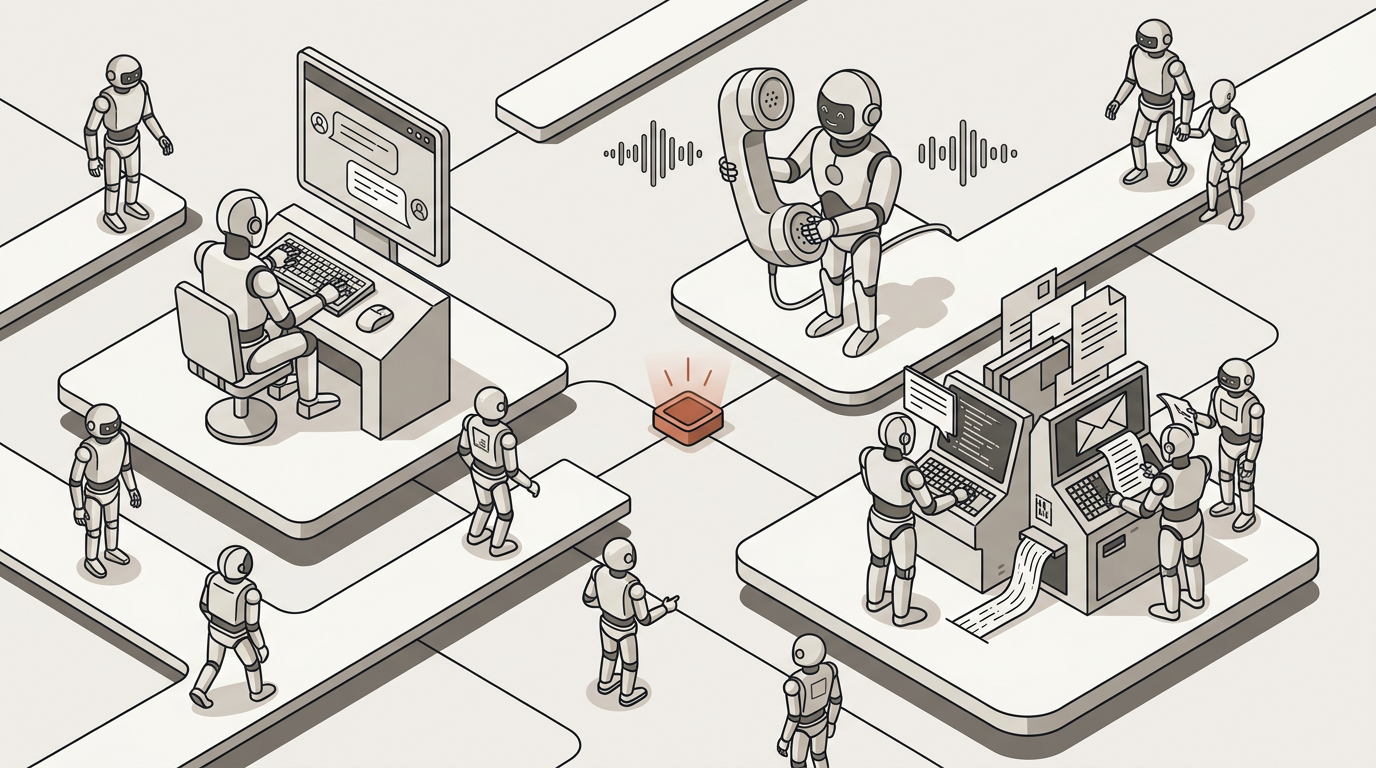
Since 2 August 2026, Article 50 of the AI Act has required that anyone talking to an AI system knows it, clearly and at the latest when the interaction starts, unless that is obvious. That design duty sits with the system's provider; the firm that uses it — the "deployer" — has narrower duties of its own, such as disclosing AI-generated text it publishes on matters of public interest without human review. In practice, if your website, client portal or phone line is answered by an AI agent, the prudent course is for it to say so in its first sentence.
What does Article 50 of the AI Act say?
Regulation (EU) 2024/1689 (opens in new tab), the AI Act, devotes Article 50 to transparency. Its first paragraph is the one that matters most to a professional firm:
"Providers shall ensure that AI systems intended to interact directly with natural persons are designed and developed in such a way that the natural persons concerned are informed that they are interacting with an AI system, unless this is obvious from the point of view of a natural person who is reasonably well-informed, observant and circumspect, taking into account the circumstances and the context of use."
The whole article, in plain words:
| Paragraph | Who | What it requires |
|---|---|---|
| 50(1) | Provider | Design the system so that people interacting with it know it is an AI, unless that is obvious. |
| 50(2) | Provider | Mark synthetic audio, image, video or text in a machine-readable format, so it can be detected as artificial. |
| 50(3) | Deployer | Inform people exposed to emotion recognition or biometric categorisation. |
| 50(4) | Deployer | Disclose deep fakes, and AI-generated text published to inform the public on matters of public interest — unless it had human review and someone holds editorial responsibility. |
| 50(5) | Both | Inform clearly, distinguishably and accessibly, at the latest at the first interaction or exposure. |
The "obvious" exception is read narrowly: among the cases that are not obvious, the Commission lists helpdesk chatbots where users may take the replies for a person's.
Who carries the duty: the provider or your firm?
A provider develops an AI system, or has one developed, and places it on the market or puts it into service under its own name or trademark (Art. 3(3)); a deployer uses it under its authority in a professional activity (Art. 3(4)). If you subscribe to a platform, the company that builds it is normally the provider and your firm the deployer.
The line is not always sharp. The European Commission's Article 50 guidelines (opens in new tab) (20 July 2026) treat as a provider an organisation that puts its own chatbot into service under its name, and anyone who modifies an existing system and puts it into service under its name. If you configure an agent with your brand, your documents and your instructions, ask your legal adviser which role you hold.
As a deployer, your firm must disclose AI-generated text it publishes on matters of public interest — a blog post on a tax change, say — without genuine human review. And although the paragraph 1 notice is the provider's, it pays to own it:
- You decide what your client sees and hears: the chat text, the phone greeting, the email footer.
- Your sectors are sensitive ones: in financial advice, insurance, legal assistance and health, the Commission sees reminders as likely to be needed, not just one notice at the start.
- GDPR applies on its own terms: you must tell clients how you process their data, including when AI is involved.
What applies since 2 August 2026, and what did the Omnibus change?
Article 113 sets 2 August 2026 as the general date of application, and Article 50 falls under it. Regulation (EU) 2026/1744 (opens in new tab), the "Digital Omnibus on AI", entered into force on 27 July 2026 and changed three things:
- It deferred high-risk rules to 2 December 2027 (Annex III) and 2 August 2028 (Annex I).
- It gave until 2 December 2026 to providers of generative systems placed on the market before 2 August for the technical marking in paragraph 2 (new Article 111(4)).
- It rewrote paragraph 7, on codes of practice.
The notice that you are talking to an AI and the labelling in paragraph 4 have applied since 2 August, with no grace period. Content generated earlier need not be labelled retroactively; if you publish it afterwards, it must be. Beyond Article 50, the AI-literacy duty (Article 4) has applied since February 2025, and the Omnibus has softened it: take measures to support your team's AI literacy.
Supervision and fines. Breaching Article 50 can cost up to €15 million or 3% of worldwide annual turnover, whichever is higher; for an SME, whichever is lower (Art. 99(4) and 99(6)). Each Member State sets its own regime. In Spain, for example, the government approved on 26 May 2026 the draft organic law (opens in new tab) that makes AESIA, created by Royal Decree 729/2023 (opens in new tab), the central supervisory body; on 5 October 2026 it was still before Parliament (opens in new tab), in the amendment stage.
Channel by channel: what to disclose, when and how
| Channel (example) | Does Article 50 apply? | What to say, and when |
|---|---|---|
| An accounting firm's website chat | Yes: direct interaction (50(1)) | That it is the firm's AI assistant and the client can ask for a person. Before or in the first message. |
| Client-portal assistant | Yes (50(1)) | The same at the start of each conversation; a reminder if the subject turns sensitive. |
| A clinic's phone line (bookings and admin, nothing clinical) | Yes (50(1)) | In the greeting, before asking for details. Repeat it if the call runs long. |
| A law firm's enquiry form | Only if an AI converses | That it is an AI, gives no legal advice, and a lawyer will review the matter. |
| Email the AI drafts and a professional reviews and sends | Generally no, if the review is real | Optional: one line in the signature. If the "review" is a click, treat it as automatic. |
| Email an agent sends without review | Yes (50(1)) | A visible label at the top of the email, not hidden in the footer. |
| A report drafted with AI for one client | Not "published" text; technical marking is the provider's job | Recommended: a note in the template. If it goes out unreviewed, always say so. |
| Hand-off to a person | The client must know which replies came from the AI | Say who is taking over and flag it if the AI answers again. |
| A blog post on a tax change | Yes, if the text is AI-generated (50(4)) | A label at the start, unless genuinely reviewed with an identified editorial owner. |
Scripts: how to say it without it reading like small print
A good disclosure says "artificial intelligence" or "AI", not just "assistant"; says on whose behalf it speaks; offers a way to a person; says what it does not do; and repeats itself when the client asks. Three examples:
- Website chat: "Hello, I'm [Firm]'s artificial intelligence assistant. I answer from our website and our documents. If you'd rather speak to a person, just say so."
- Phone: "Hello, you've reached [Clinic]. You're speaking to an artificial intelligence assistant: I can book an appointment or put you through to reception."
- Hand-off: "I'm passing you to [Name] from our team. From now on a person is replying, and they can see the whole conversation."
The guide AI disclosure scripts for professional firms has the full set — portal, email footers, a note for documents, a privacy-notice paragraph — in English and Spanish.
What if a professional reviews what the AI drafts?
Two rules get mixed up here.
The paragraph 4 exception only covers published text. AI-generated text published on matters of public interest needs no label if a person has reviewed it and someone holds editorial responsibility. Per the guidelines, review means examining the substance with relevant knowledge and professional judgement, fact-checking at the very least. Spell-checking, cursory approval or automated review do not count, and if AI changes the substance afterwards, the exception is lost.
An email to a client is not "published" text. The guidelines give private professional correspondence and a consultant's advice to a client as examples. For an email, the question is the paragraph 1 one: if a professional reviews the draft and sends it, the client is not talking directly to an AI. But the mere possibility of review is not enough.
The working rule: if no professional has read the substance, the client should know an AI wrote it.
How it's done in MosenAI (and what it doesn't do for you)
There is no switch that makes your firm comply with Article 50, and no automatic notice that excuses you from setting it up. What you do, across your firm's channels:
- The notice, in the first thing the client sees or hears: the header text of your website chat, shown before the first message, and the greeting the voice agent speaks when it answers. Write them yourself; don't leave the generic one.
- Your firm's standing instructions, which apply to every agent: introduce itself as an AI assistant, confirm it whenever asked, never claim to be a person, and offer someone from the team. It replies in your client's language, and so does the notice. These are instructions to the model: review conversations to check it follows them.
- Explicit hand-offs: you write the message for office hours, out of hours and before a call is transferred; whoever takes over has the whole conversation in front of them.
- Review before sending: in an automation, a review step before an email or document goes out, with the sources in view. The "drafted with AI assistance" note goes in your template.
- Everything on the record: everything an agent did is exportable, so you can show what your client saw.
More context: chatbot vs AI agent and what an accounting firm should automate first.
What Article 50 is not
- It is not high-risk. An agent that answers questions, books appointments or requests documents is not high-risk for that reason. Other uses can be, such as assessing individuals' creditworthiness or pricing life and health insurance (Annex III).
- It does not replace GDPR. Transparency does not make the processing lawful; your information duties remain (Articles 13 and 14 GDPR (opens in new tab)).
- It is not a seal. There is no official Article 50 certificate.
- It does not require labelling everything. An internal assistant for a trained team can be an "obvious" case, and correcting spelling is not generating content.
Where your data lives and what is on the record
A clear notice is half of trust; the other half is being able to explain where your clients' data is and what each agent did. Read where your data lives and what is on the record. And if you'd like to see it on a case of your own, book a demo.
The full scripts come with Hours Back, our fortnightly newsletter: subscribe here.
Frequently asked questions
Do I have to disclose that my website chat is an AI agent?
Designing it to disclose is the provider's duty, but you decide the text your client sees. Anyone writing in that chat must know from the start that it is an AI, and in a service chat that is rarely obvious.
Do we have to repeat the notice in every message?
No. One prominent notice at the start usually suffices, with reminders in riskier contexts — finance, insurance, legal, health — and whenever someone asks whether it is an AI.
Do we have to label emails the AI drafts?
If an agent sends them without review, yes. If a professional reviews the substance and sends them, generally not; a line in the signature is a trust decision.
What is the fine for not disclosing?
Up to €15 million or 3% of worldwide turnover; for an SME, whichever is lower. In Spain, the law setting the national regime was still before Parliament on 5 October 2026.
This article is for information and is not legal or tax advice.