Spain's e-invoicing and Verifactu deadlines: what accounting firms must tell their clients
Updated 7 October 2026
Spain's mandatory B2B e-invoicing now has a running clock: ministerial order Orden HAC/1028/2026 (opens in new tab) entered into force on 6 October 2026, giving businesses with a VAT turnover above €8 million 12 months to comply and everyone else 24. Verifactu, the rules on invoicing software, is up in the air: under current law it falls on 1 January 2027 for companies and 1 July 2027 for the self-employed, but the Ministry of Finance has announced it will move it to October 2028, and the rule that formalises that is not yet published. If you advise clients in Spain, each of them needs to hear what applies to them, and when — here is the calendar, a way to segment your client list, three emails ready to send, and a short table of the other EU mandates.
What changed this week?
In four lines:
- On 5 October Spain's official gazette (BOE) published Orden HAC/1028/2026, which regulates the AEAT's public e-invoicing solution: format (UBL syntax on the European EN 16931 model), sending, invoice statuses and access. It entered into force on the 6th.
- It was the missing piece. It starts the clock of Royal Decree 238/2026 (opens in new tab), which implements the obligation created by article 12 of Law 18/2022, known as "Crea y Crece" (opens in new tab).
- The public solution will be free and must be available at least two months before the first phase.
- Verifactu keeps its own calendar, set by Royal Decree-law 15/2025 (opens in new tab). That rule is still in force, but the Ministry has announced it will postpone Verifactu to October 2028 (see below).
If you saw "1 October 2027", it came from the draft order (opens in new tab), which planned to enter into force on 1 October 2026. The published order took effect on the 6th.
And news on Verifactu. On 5 October the Ministry of Finance announced it will postpone the pending obligations of the Verifactu regulation to October 2028, to line them up with B2B e-invoicing (El Español (opens in new tab), in Spanish). The technical requirements — integrity, retention, accessibility, legibility, traceability and inalterability — are to stay substantially the same. But this is an announcement, not a rule: the amending regulation is still missing, and until it appears in the BOE the legally binding dates remain 1 January and 1 July 2027. The table below shows both.
The calendar in one table
| What | Who | From when | Source |
|---|---|---|---|
| Verifactu: compliant invoicing software | Corporate-tax payers (except those on SII) | Before 1 January 2027 (date in force). Announced: October 2028, rule pending | RDL 15/2025, final provision 1 (opens in new tab) |
| Verifactu | Self-employed (IRPF), pass-through entities, non-residents with a permanent establishment (except SII) | Before 1 July 2027 (date in force). Announced: October 2028, rule pending | RDL 15/2025, final provision 1 (opens in new tab) |
| AEAT public solution live | All businesses and professionals | At least two months before phase 1 | Orden HAC/1028/2026, add. provision 2 (opens in new tab) |
| B2B e-invoicing, phase 1 | VAT turnover ("volumen de operaciones") above €8M in the previous calendar year | 12 months from 6 October 2026: October 2027 | RD 238/2026, final provision 4.1(a) (opens in new tab) |
| Legible PDF alongside each e-invoice | Phase-1 issuers, for their first 12 months (unless the recipient accepts the original format) | October 2027 to October 2028 | RD 238/2026, transitional provision 2 (opens in new tab) |
| B2B e-invoicing, phase 2 | All other businesses and professionals | 24 months from 6 October 2026: October 2028 | RD 238/2026, final provision 4.1(b) (opens in new tab) |
| Reporting invoice status, including payment | Self-employed individuals and pass-through entities up to €8M | 12 months after their phase: October 2029. Voluntary until then | RD 238/2026, transitional provision 3 (opens in new tab) |
A note on days. The decree sets the e-invoicing deadlines in months from 6 October 2026, not as calendar dates. Counted date to date, they would fall on 6 October 2027 and 6 October 2028, but the AEAT has not yet published an exact day. Until it does, tell clients "October 2027" and "October 2028", and plan with room to spare.
Which clients does it affect, and what does each one need to do?
Segment with two questions: who the client is (that sets their phase) and how they invoice today (that sets how much work they have ahead).
By who they are:
- Businesses above €8M of VAT turnover. E-invoicing from October 2027 and, for their first twelve months, a legible PDF with every e-invoice unless their customer accepts the original format alone. Verifactu before 1 January 2027 if they are companies (date in force; October 2028 announced) — unless they keep their VAT books through SII, Spain's immediate VAT reporting system: the Verifactu regulation (opens in new tab) does not apply to SII filers (art. 3.3). E-invoicing does.
- Other companies. Verifactu before 1 January 2027 (date in force, same SII exception; October 2028 announced) and e-invoicing in October 2028. Note that from October 2027 they may start receiving e-invoices from large suppliers. If they have not agreed a private platform with those suppliers, the decree treats the public solution as their receiving point (RD 238/2026, art. 6).
- Self-employed clients (autónomos). Verifactu before 1 July 2027 if they invoice with software (date in force; October 2028 announced); B2B e-invoicing in October 2028; invoice-status reporting twelve months later.
- Clients who only invoice consumers. The obligation covers business-to-business transactions (art. 3), and simplified invoices are excluded unless they are "qualified" ones (art. 4). Verifactu still applies if they invoice with software.
- Clients under the Basque or Navarrese tax regimes. Review them separately: the decree defers to agreements with those regional tax authorities (additional provision 3).
By how they invoice today:
- With invoicing software. Two questions for the vendor: does it have a Verifactu "declaración responsable" (the producer's self-declaration, art. 13 of the regulation)? How will it send and receive e-invoices? There is no AEAT "certification" for Verifactu; the declaration is what exists.
- With Word or Excel. According to the AEAT's FAQ (opens in new tab), if they only use them to type, print and keep invoices, Verifactu does not apply; if they generate VAT books or accounts with them (with a macro, say), it does. For e-invoicing, a Word file or a PDF will not do: it must be a structured message (RD 238/2026, art. 7). The AEAT offers a free invoicing application (opens in new tab) and will build a free form for issuing e-invoices (additional provision 1).
- By hand, from a paper invoice book. Verifactu does not apply, because no software is involved. B2B e-invoicing does, when their phase arrives.
Three emails ready to send to your clients
Fill in the brackets and adjust the tone to how you usually write to each client. Until the rule moving Verifactu to October 2028 is published, use the 2027 dates in force and mention the announcement, as in the first email.
1. First notice: what changes and when it applies to you
2. What we need from you
3. Reminder before the deadline
A checklist for the firm
- [ ] Client inventory: legal form, above €8M?, on SII?, invoices businesses or consumers?, invoicing software, declaración responsable yes or no.
- [ ] Give every client their two dates: Verifactu and e-invoicing.
- [ ] Flag clients near the €8M line (how they close the year can move them between phases) and clients under the Basque or Navarrese regimes.
- [ ] Sending calendar: first notice in October 2026, data request in November, reminders 60 and 30 days before each date.
- [ ] One internal answer sheet, so the whole team gives the same answer to "does this affect me?".
- [ ] Decide what your fee covers and what is a separate service: choosing software, setting up the platform, training the client.
- [ ] Plan for the volume of questions, especially when the rule setting Verifactu's new calendar is published and in the weeks before each date: who answers, and how fast.
- [ ] To use the AEAT form on a client's behalf, your firm must be registered as their representative (apoderado) in the AEAT's register of powers of attorney (order, art. 11.2).
- [ ] Your own firm invoices businesses too: check your software and your phase.
- [ ] Watch the BOE and the AEAT's site: for the rule that formalises the Verifactu postponement and for the announcement that the public solution is live.
Where does automation fit (and where doesn't it)?
With a hundred or two hundred clients, the work is not understanding the regulation. It is sending the right email to each client, collecting the answer, and replying to the same question many times. That is where an AI agent helps:
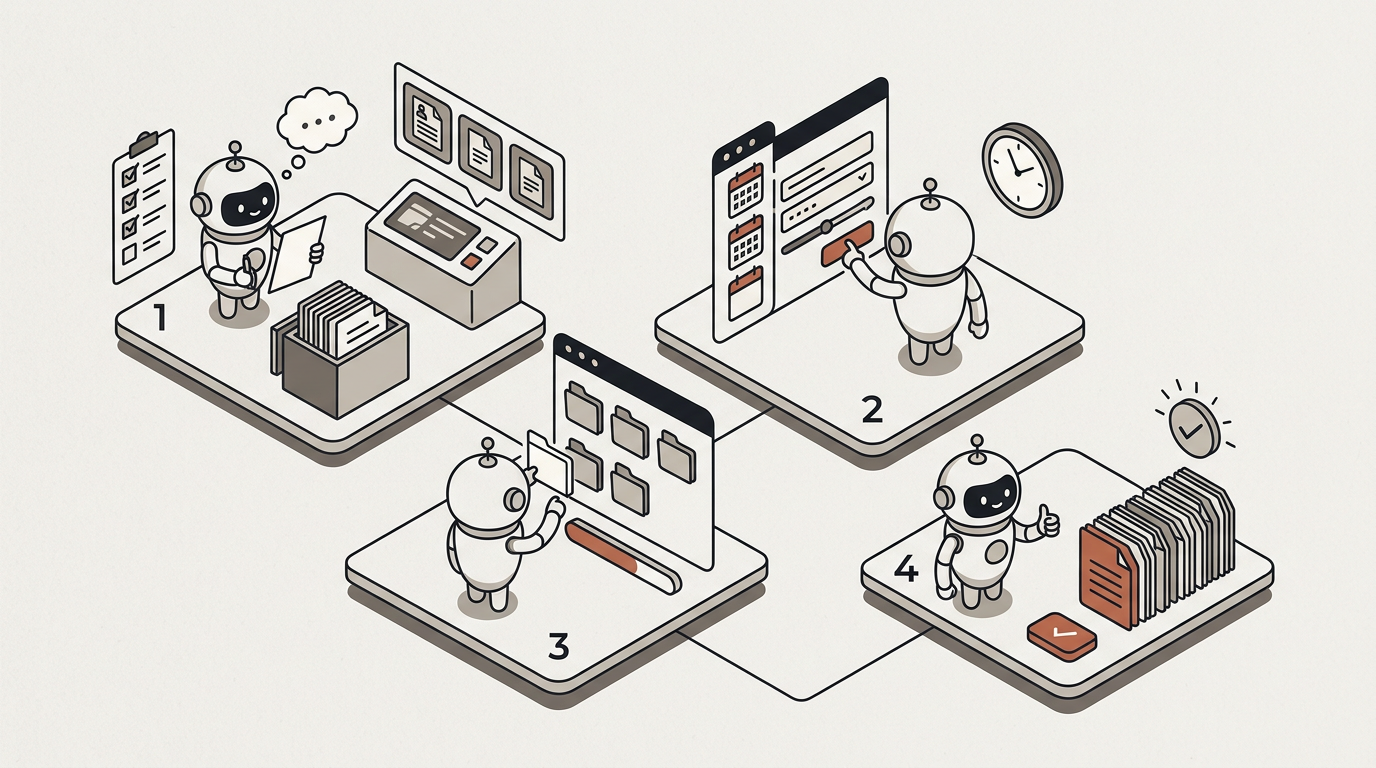
- Sending notices by segment, on schedule. A scheduled automation sends each group its email from your firm's own address, and a reminder to anyone who has not replied.
- Finding out which software each client uses. A form on your client portal, or a reply to the email itself, puts the answer on the client's record; anything unclear goes to a person.
- Answering the repeated "does this affect me?". An agent answers from your firm's own notes and cites the source. Edge cases — the client near €8M, the one on SII, the Basque one — go to a person in your team with the whole conversation in front of them.
To be clear: MosenAI is not invoicing software. It does not issue invoices, it does not make anyone Verifactu-compliant, and it does not sign in to the AEAT's site or its public e-invoicing solution, both of which require a digital certificate or Cl@ve. Deciding what each client needs remains your adviser's job.
To see how this kind of flow is put together, read about back-office automation and what we do for accounting and advisory firms. If your other bottleneck is clients who never send their paperwork, continue with how to stop chasing client documents. For the full picture, see AI for accounting firms.
What about clients elsewhere in the EU?
Spain is not alone, and if your clients are established in other member states, their own country's calendar applies there:
| Country | B2B e-invoicing mandate | Source |
|---|---|---|
| Belgium | Structured e-invoicing between VAT-registered businesses since 1 January 2026 | FPS Finance (opens in new tab) |
| Poland | KSeF since 1 February 2026 for sales above PLN 200M in 2024, since 1 April 2026 for the rest; the smallest invoicers until the end of 2026 | KSeF (opens in new tab) |
| France | Since 1 September 2026, every business must be able to receive and large and mid-sized ones must issue; SMEs and micro-businesses issue from 1 September 2027 | impots.gouv.fr (opens in new tab) |
| Germany | Receiving since 2025; issuing mandatory from 1 January 2027, except for businesses with prior-year turnover up to €800,000, which have until the end of 2027 | Federal Ministry of Finance (opens in new tab) |
| All EU | Cross-border B2B transactions move to e-invoicing with digital reporting from 1 July 2030 (VAT in the Digital Age) | European Commission (opens in new tab) |
The communication problem is the same in every one of these countries: different clients, different dates, the same questions. The segments, emails and checklist above travel well.
Frequently asked questions
Are Verifactu and mandatory e-invoicing the same thing?
No. Verifactu governs the software used to issue invoices, so that records cannot be altered (Royal Decree 1007/2023). Mandatory e-invoicing governs the format, the exchange between businesses and the tracking of payment (Law 18/2022 and Royal Decree 238/2026). They meet: RD 238/2026 requires e-invoices to be produced by software that meets those same requirements (art. 2(d)).
Does a self-employed client who invoices in Word or Excel need to change?
For Verifactu, it depends on use: typing, printing and keeping invoices, no; generating VAT books or accounts from the spreadsheet, yes. For invoicing businesses from October 2028, yes: a Word file or a PDF is not an e-invoice under this decree.
Will invoices to consumers have to be electronic too?
Not under this decree, which covers transactions between businesses and professionals. Simplified invoices are excluded unless they are qualified ones.
Does the AEAT's public solution cost anything?
No. The order confirms that access and use are free.
Could the calendar change again?
It already is changing. Verifactu was postponed by Royal Decree 254/2025 (opens in new tab) and Royal Decree-law 15/2025, and the Ministry has now announced a further move to October 2028 that is not yet published in the BOE. The e-invoicing deadlines have been running since 6 October 2026. If anything changes, we will update this article.
Get Hours Back: every two weeks, one process your firm can stop doing by hand. → Subscribe
This article is for information and is not legal or tax advice.